
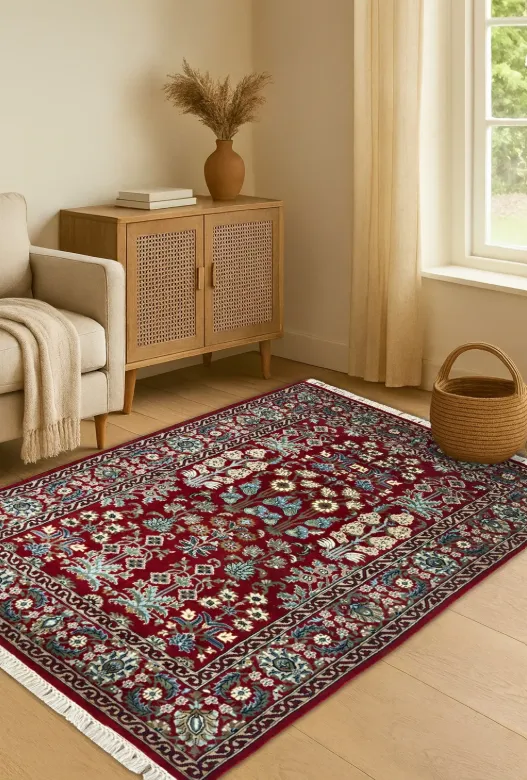
Let’s clear up one thing: red carpets are not the problem. The way most people style them is. For years, red has been treated as a difficult colour in home interiors. People either imagine a very traditional drawing room, an overly decorative hotel lobby, or simply a room where too much red is happening at once. So, when someone considers buying a red carpet, the first fear is usually: “Will this make my home look old-fashioned?”
Not necessarily.
An authentic handmade red carpet can look strikingly current in a modern Indian home. The problem begins when buyers treat all reds as the same and all red carpets as statement pieces that more statement furniture, more patterns, and more colour must support.
That is exactly backwards. A red carpet should carry the visual energy of the room so the rest of the room can calm down.
Deep oxblood, wine, brick, rust and muted crimson can work very differently from bright primary red. Recent interior colour discussions are also moving towards deeper, more complex colour combinations rather than playing everything safe with endless beige and grey.
The question is not whether red works. The real question is: which red works in your home, and how much of it can the room handle?
Do Red Carpets Make a Room Look Too Dark or Old-Fashioned?
No. A red carpet usually makes a room look dark only when the red is paired with too many other heavy elements or the room does not have enough visual balance.
This is where the reputation of red carpets has suffered. A deep red rug placed with dark furniture, heavy curtains, dark walls, and multiple gold accessories can certainly make a room feel visually heavy. But that does not mean the carpet itself is the problem.
A red carpet becomes outdated when the entire room starts following the same decorative script.
A red carpet can look modern when you pair it with:
- Light or medium-toned walls.
- Cream, off-white, or warm neutral upholstery.
- Natural wood furniture.
- Black accents used in moderation.
- Contemporary lighting.
- Cleaner furniture shapes.
- Fewer decorative objects around the rug.
The simplest rule is this: If the carpet is visually strong, reduce the visual noise above it.
This is especially important with traditional red carpets containing floral or detailed motifs. You do not need equally detailed cushions, curtains, and wall art competing for attention.
The modern Indian approach to red
Instead of matching everything perfectly, repeat the red family once or twice elsewhere.
For example:
- A wine-red rug with one rust cushion.
- A brick-red rug with warm-toned artwork.
- A deep crimson rug with a small burgundy accessory.
- A muted red rug with brown wood and cream upholstery.
The colour connection should feel intentional without turning the room into a red-themed project.
Key note: Red works best when it is allowed to be the strongest colour, not one of five competing strong colours.
Which Shade of Red Carpet Looks Best in a Modern Indian Home?
Deep and muted reds are generally easier to style than bright primary red because they add warmth without dominating the entire room.
This is one of the biggest content gaps around red carpets. People search for “red carpets” as if red is one single colour. It is not. The difference between a bright scarlet carpet and a deep oxblood carpet is enormous.
| Red Shade | Overall Feel | Best With | Where It Works Well |
| Oxblood | Deep and refined | Cream, walnut, black | Modern living rooms |
| Burgundy | Rich and warm | Beige, taupe, brass | Formal spaces |
| Brick Red | Earthy and relaxed | Wood, cream, olive | Contemporary Indian homes |
| Rust Red | Soft and natural | Sand, brown, sage | Casual living spaces |
| Crimson | Bold and dramatic | Ivory, charcoal, muted gold | Statement interiors |
| Bright Red | Energetic and traditional | Neutrals and simple furniture | Smaller accent areas |
Avoid choosing red from the product photo alone. Red is heavily affected by lighting.
A handmade carpet that looks like a sophisticated wine colour under studio lighting may appear much brighter in direct sunlight. A dark burgundy can also look nearly brown or black in a poorly lit room.
Before buying, consider:
- How much natural light the room receives.
- Whether your lighting is warm or cool.
- The colour of your flooring.
- The dominant colour of your sofa.
- Whether the rug is solid or patterned.
Key note: The darker and more complex the red, the more furniture and lighting influence the way it appears in your home.
Can a Red Carpet Work With a Modern Sofa?
Yes. In fact, a red carpet often works better with modern neutral furniture than with furniture that is already highly decorative.
The safest mistake is buying a neutral rug for a neutral sofa. Everything matches, but nothing actually happens. A red abstract carpet can become the element that gives a modern sofa arrangement some identity.
Red carpet with a cream or beige sofa
This is one of the easiest combinations. The light upholstery gives the eye a place to rest while the carpet provides warmth and depth. It works particularly well with wood, cane and brass details.
Red carpet with a grey sofa
Grey can make a red carpet look more contemporary, especially with deeper wine, brick or rust tones. However, avoid pairing a bright red rug with a very cool grey room unless you want a deliberately high-contrast look.
Red carpet with a brown leather sofa
This can work beautifully, but the red should usually be earthy or deep. Brick red, rust, and wine tones tend to sit more naturally with brown leather than bright scarlet.
Red carpet with a black sofa
This is the most dramatic option. A deep red rug can prevent a black sofa from making the room feel too severe. But keep the walls, lighting, and accessories lighter so the room does not become visually heavy.
The better question is not “What sofa matches a red carpet?” It is “What does the red carpet add that my sofa currently lacks?”
If your sofa is plain, red adds energy. If your sofa is dark, red can add warmth. If your sofa is already patterned, the red rug should usually be calmer.
Where Should You Avoid Using a Red Carpet?
Avoid a large red carpet when the room is already visually crowded or when another large red surface is competing with it. Red is powerful. That does not mean it belongs everywhere.
A red room carpet may not be the best choice when:
- The room has very busy printed furniture.
- The curtains are already bright or heavily patterned.
- The walls are a strong warm colour.
- The flooring itself has a strong red or orange undertone.
- The room is extremely small and poorly lit.
- You already have several large decorative focal points.
This does not mean you need to avoid red completely. You can use it in a more controlled way.
In a visually busy room, try:
- A smaller red rug.
- A red rug with cream or beige in the pattern.
- A deeper, less saturated red.
- A border design rather than a fully red surface.
- A runner instead of a large area rug.
The goal is not to remove colour. It is to control where the colour appears.
What about bedrooms?
A bright red carpet covering most of a bedroom can feel overstimulating for some people, especially when combined with strong bedding and wall colours.
But a muted rust, wine or brick-red rug can work beautifully in a bedroom that otherwise uses calm materials and colours.
Red does not automatically mean “too energetic”. The shade, scale and surrounding colours decide the mood.
Should You Buy a Red Carpet?
Buy a red carpet if you want the floor to become the visual anchor of the room. Do not buy one simply because you think red needs to “match” traditional Indian decor.
Before choosing one, ask:
- Is the room already visually busy?
- Which shade of red actually suits the lighting?
- Does the rug need to add warmth or drama?
- What colour is the largest piece of furniture?
- Will this red still work when you change cushions or decor later?
- Is the carpet the main statement, or are you making everything compete with it?
The strongest red interiors are not the ones with the most red. They are the ones where red has been given a clear role. A good red carpet does not make the room louder. It gives the room a pulse. And that is the real reason red carpets are worth reconsidering. Not as a traditional default. Not as a “bold colour choice.” But as one of the most effective ways to give an otherwise safe room an actual point of view.
